

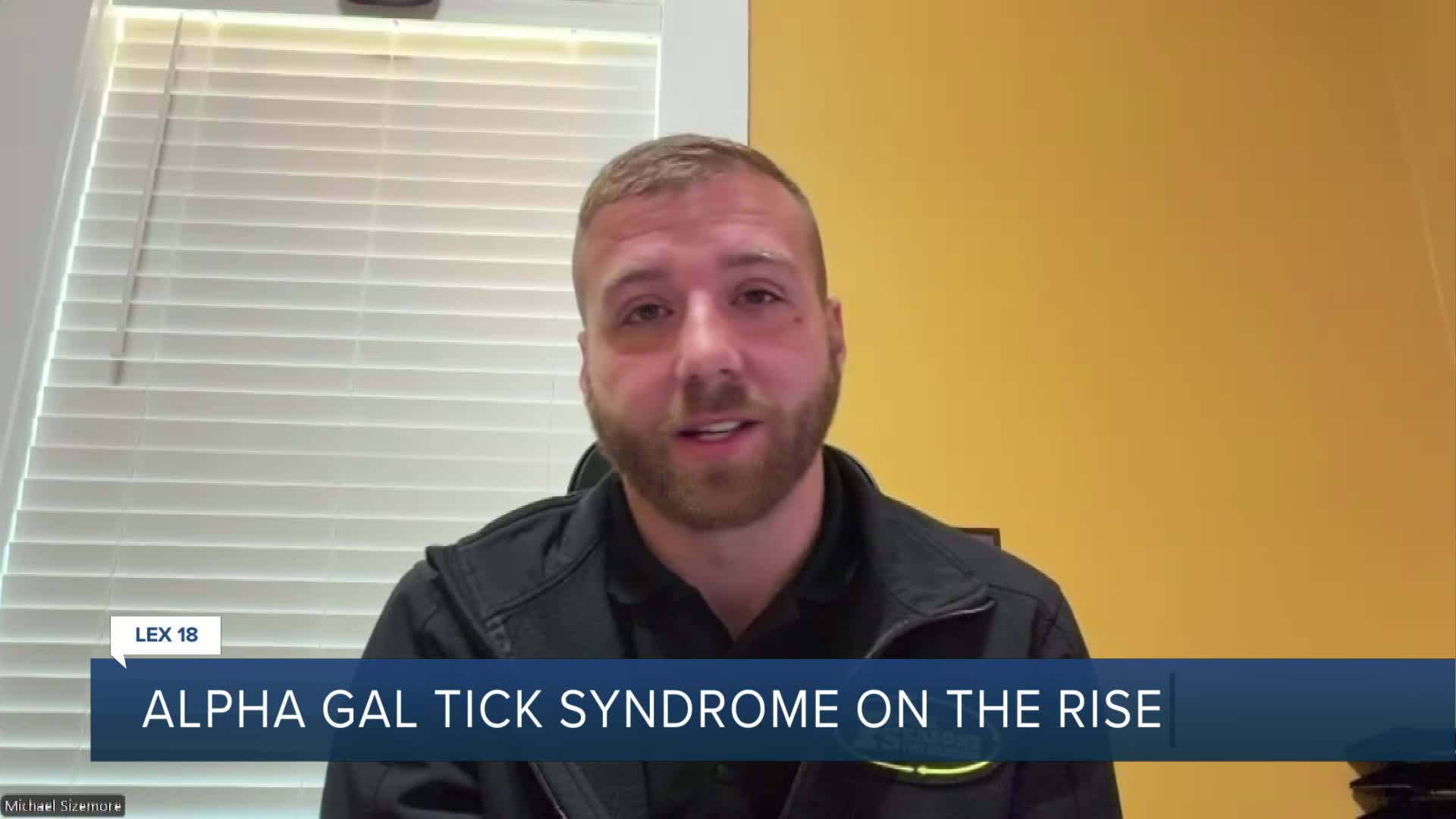


(LEX 18) — Michael Sizemore thought he was having a normal weekend. He was outside building a chicken coop for his wife and three kids when he discovered a tick bite behind his knee.
"It was on a Saturday," Sizemore said. "And I come to work Monday morning and go to work and then my leg itched right behind my knee. So I reached down and I was like, God, that itches, and I felt a welp. And I was like, what's that? I pulled it up, there's a tick."
At first, he wasn't concerned.
"I kept it and I made a joke and I was like, well, I was like, he may kill me, but I'll kill him first," Sizemore said.
But weeks later, his condition took a serious turn.
"Four weeks later, I'm sicker than a dog. I mean, I'm just, I can't explain what was going on with me. I had terrible reflux and chills, no appetite. My heart rate was getting up to like 180 beats a minute," Sizemore said.
A cardiologist at Baptist Health eventually identified the cause.
"He ran a tick panel and two days later, they called me on a Saturday and he said, or his assistant, she said, you have alpha gal syndrome. And I was like, you're kidding? She said no," Sizemore said.
Alpha gal syndrome is linked to certain tick bites and can trigger serious allergic reactions to mammal products.
"A lone star tick or a deer tick would feed on a mammal, and then when it bites another host, a human, it injects that molecule into the bloodstream of the host. So the immune system recognizes that and attacks it," Sizemore said.
Ticks are most active in wooded areas and tall grass. Something as small as a single bite can trigger the condition, leaving people allergic to foods many eat every day.
For Sizemore, that reality has reshaped his daily routine.
"I can't eat at any restaurants. I have to meal prep everything. I mean, me and my wife, every Saturday and Sunday, we meal prep everything for my week," Sizemore said.
Now, Sizemore is pushing for better food labeling to help others living with the condition.
"Me and thousands of others would really appreciate it stuck on the label that it's alpha gal friendly, you know, cause there's, you know, vegan and dairy-free, soy-free. We have all that, gluten-free. We have all that. But it'd be really nice to have alpha gal friendly somewhere on there too," Sizemore said.
For now, Sizemore says he is learning to live with alpha gal syndrome and holding out hope that a cure will one day be found.
