

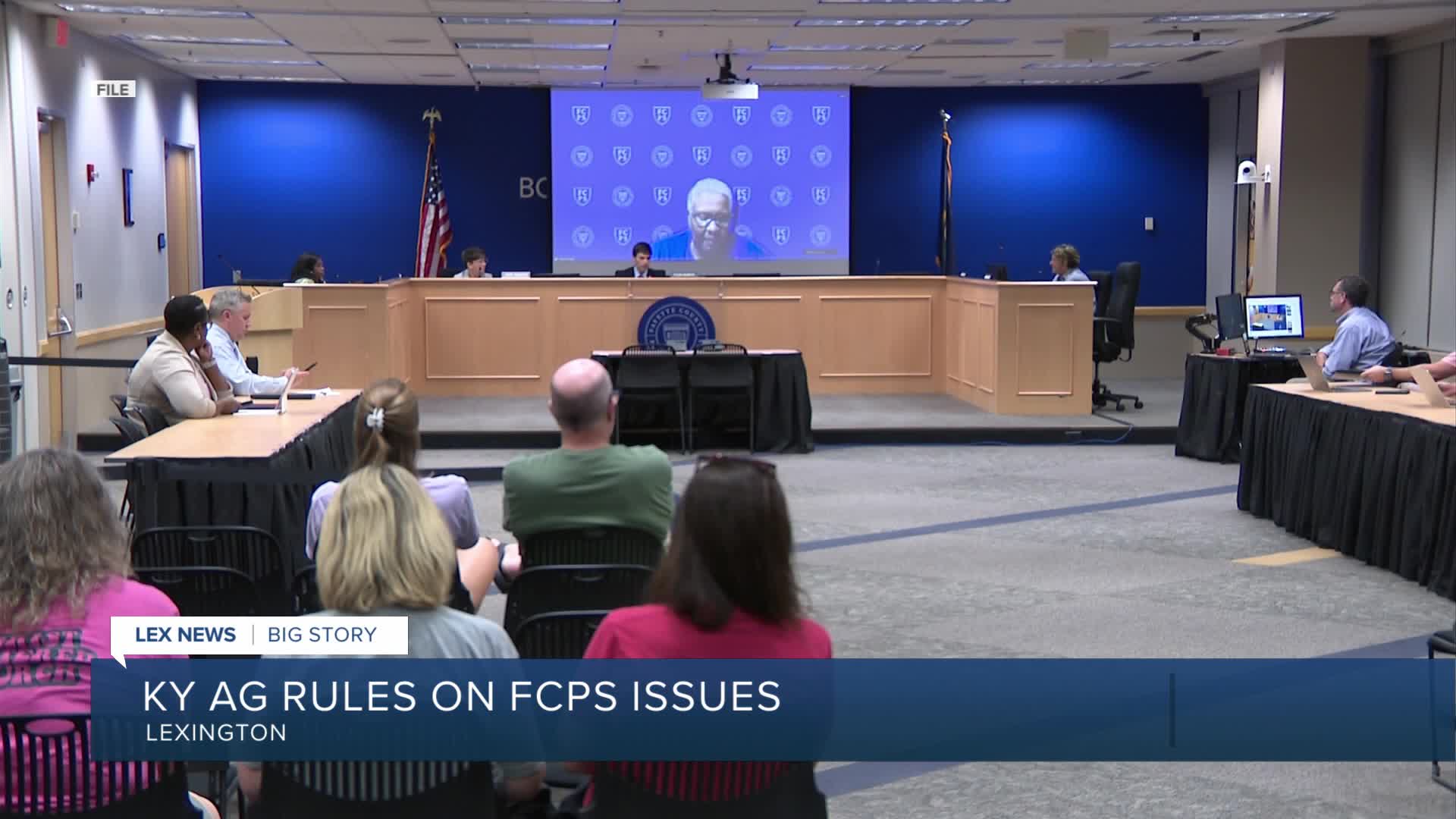


FAYETTE COUNTY, Ky. (LEX NEWS) — The Commonwealth of Kentucky has filed a motion to dismiss a lawsuit challenging portions of Senate Bill 4, a law enacted April 14, that restricts who can serve on school boards in the state's largest school districts.
The case, filed in Franklin Circuit Court, pits plaintiff Tyler Murphy — the chair of the Fayette County Board of Education — and the Kentucky Education Association against the Commonwealth of Kentucky.
At the center of the dispute is SB 4, which amended a statute to bar employees of any board of education in Kentucky who work more than 100 days per year from serving on a local board of education in a "large school district."
Under the law, a large school district is defined as one with more than 300,000 inhabitants. Currently, only Fayette County and Jefferson County school districts meet that threshold.
Section 19 of the Act allows current board members who do not meet the new eligibility criteria to finish their existing terms, but bars them from seeking an additional term once their current terms expire.
Murphy is identified in court documents as the only current local school board member in the Commonwealth directly affected by the challenged provisions.
Murphy and the Kentucky Education Association allege that Sections 7 and 19 of SB 4 violate the Kentucky Constitution's prohibition on local and special legislation, and that the law denies Murphy equal protection of the laws. They also sought a permanent injunction blocking the law's implementation and enforcement.
The Commonwealth, represented by attorneys from the Office of the Attorney General, argues the lawsuit should be dismissed in its entirety with prejudice.
In its motion, the Commonwealth contends the General Assembly has broad authority under Section 183 of the Kentucky Constitution to "provide for an efficient system of common schools throughout the State," including the power to set eligibility criteria for school board members. The filing argues that authority has historically allowed the legislature to impose minimum education requirements for board candidates, empower the Kentucky Board of Education to remove local board members, and disqualify members on grounds of nepotism.
On the question of whether SB 4 constitutes special or local legislation, the Commonwealth argues the law's population-based classification applies equally to any school district that grows beyond 300,000 inhabitants — making it an "open class" that is not fixed to any specific county or district by name.
"Mere ordinary population growth or population loss determines who is affected by Section 7 and who is not," the filing states.
The Commonwealth further argues the classification carries a rational basis: larger school districts face unique challenges, including more students, more schools, larger budgets, and more complex operations.
The filing points to what it describes as "well-documented financial and management difficulties currently being experienced by the Fayette County Board of Education" as evidence that larger districts require board members whose loyalties are not divided between their employer and the district they serve.
On the equal protection claim, the Commonwealth argues rational basis scrutiny applies because the plaintiffs' claims do not involve fundamental rights or suspect classes. Under that standard, the filing contends, a law must be upheld if there is any reasonably conceivable set of facts that could provide a rational basis for the classification.
The Commonwealth also argues the plaintiffs' motion for summary judgment and permanent injunction must be denied, stating the plaintiffs are not entitled to judgment as a matter of law.
