

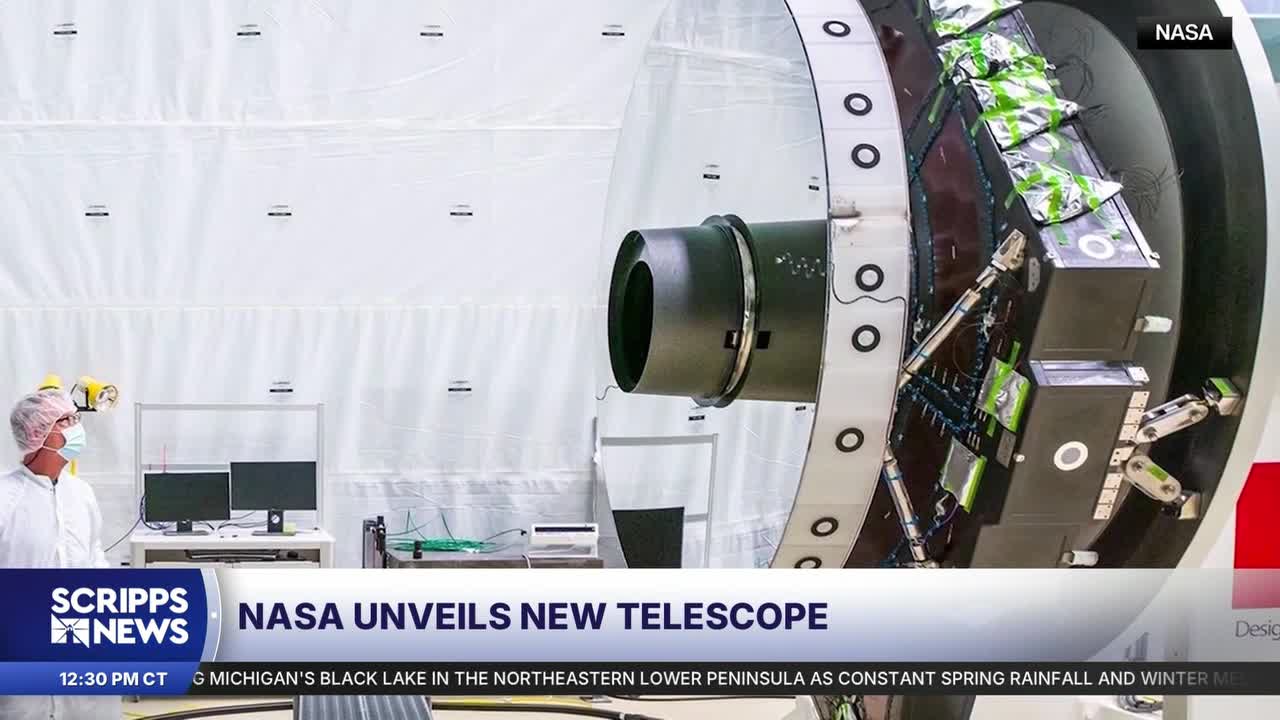


Just off its successful Artemis II mission around the moon, NASA has unveiled its fully assembled Nancy Grace Roman Space Telescope.
The next-generation observatory is named for NASA’s first chief of astronomy, who helped create the Hubble Space Telescope.
The Roman telescope can capture images 100 times larger and 1,000 times faster than Hubble. It is scheduled to launch from Kennedy Space Center in September.
RELATED STORY | Artemis II crew splashes down in Pacific, ending historic moon mission
Originally, the telescope was expected to launch in May 2027. But NASA Administrator Jared Isaacman said it was completed eight months ahead of schedule, prompting the agency to move up the launch date. NASA plans to use the Roman telescope to document deep space objects, including exoplanets.
“Roman will help answer some of the biggest questions in science — investigating dark matter, dark energy and the structure of the universe,” Isaacman said. “Its images will be so large and detailed, there isn’t a screen in existence big enough to display them.”
Part of Roman’s mission is to document 12% of the sky in high detail.
“This survey is going to be a spectacular map of the cosmos — the first time we have Hubble-quality imaging over a large area of the sky,” said David Weinberg, an astronomy professor at Ohio State University. “Even a single pointing with Roman needs a whole wall of 4K televisions to display at full resolution. Displaying the whole high-latitude survey at once would take half a million 4K TVs, enough to cover 200 football fields or the cliff face of El Capitan.”
RELATED STORY | After splashdown, NASA pushes back on heat shield concerns spreading online
One mystery scientists have long been perplexed by is “dark matter.” It is estimated to make up 27% of the universe. Although it can’t be seen, its existence is inferred from the gravitational effects it has on objects in space.
NASA hopes the Roman telescope will offer new insights into what dark matter is made of.
