

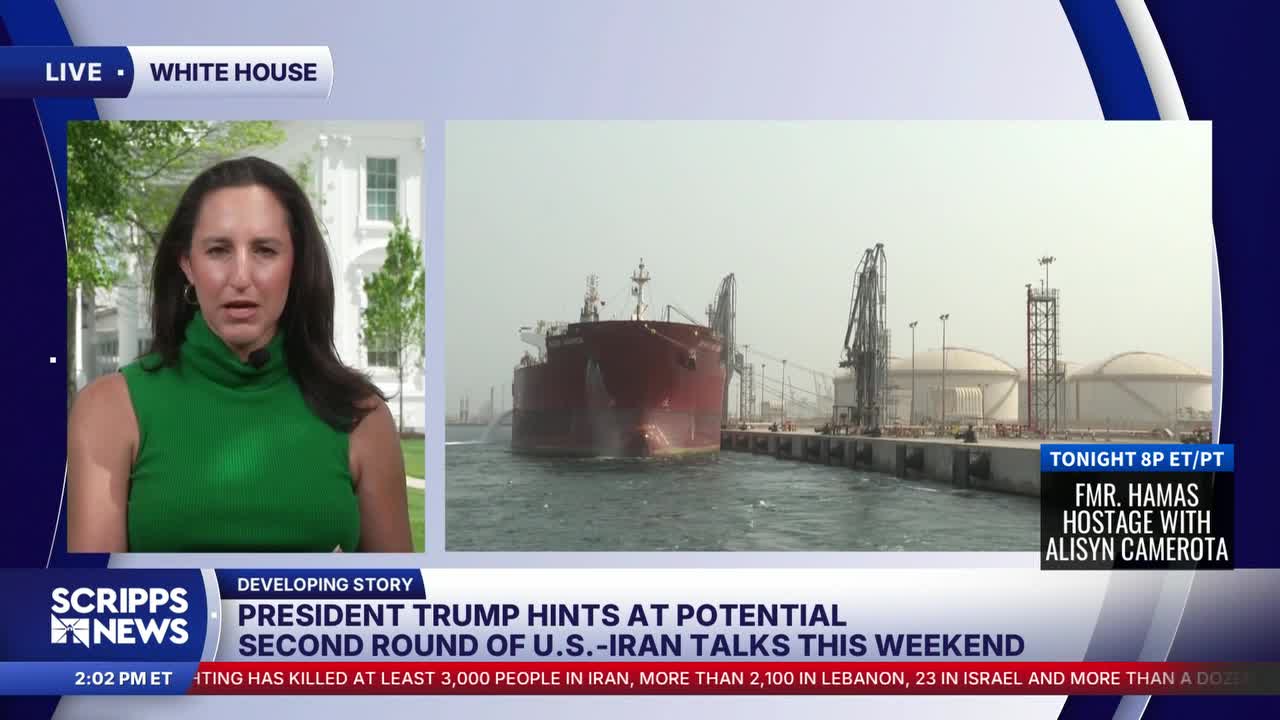


President Donald Trump is touting the opening of the Strait of Hormuz Friday amid efforts to reach a deal with Iran.
“Iran has just announced that the Strait of Hormuz is fully open and ready for business and full passage,” Trump told a crowd at a Turning Point USA event in Arizona Friday evening, after announcing it earlier in the day, noting the U.S. naval blockade would end “when the agreement is signed.”
“This process we’re getting along well but who knows who knows with anyone but who knows with Iran in particular. This process should go very quickly in that most of the points are already negotiated and agreed to,” Trump said.
Trump told Axios in an interview “I think a meeting will probably take place over the weekend. I think we will get a deal in the next day or two.”
“Talks are going on and it’ll go on over the weekend, and a lot of good things are happening, and that includes Lebanon too,” Trump told reporters.
Iranian Foreign Minister Seyed Abbas Araghchi announced the straits opening for the remainder of the ceasefire Friday morning. He added that vessels will be allowed to transit along “the coordinated route as already announced” by Iran’s Ports and Maritime Organization.
Tehran said the reopening was due to the announced ceasefire between Israel and Lebanon. Trump said the deal was “not tied, in any way, to Lebanon.”
RELATED STORY | US says Iran port blockade is working, forcing ships to turn back
The U.S. had implemented a naval blockade on Iranian ports to pressure Iran to reopen the Strait. Trump suggested on Friday that the blockade would remain in place until the U.S. and Iran reach a deal to end the war.
Trump said Iran “will never have a nuclear weapon,” that it with US help is removing all sea mines and that the US “will get all nuclear dust” by “going in with Iran with lots of excavators” and take it to the United States.
“We were gonna take it anyway,” he said.
The U.S.’ red lines in negotiations have included ending uranium enrichment, dismantling all major nuclear enrichment facilities, retrieving highly enriched uranium, accepting a broader peace, security and de-escalation framework including regional allies, ending funding for terrorist proxy groups and reopening the strait without tolls, according to a US official.
Ahead of operations in Iran, senior administration officials believed Iran had about 10,000 kg of enriched material, including 460 kg of 60 percent enriched uranium.
Trump told Bloomberg News in an interview Iran agreed to an unlimited suspension of its nuclear program, NewsNation that “they agreed to everything” and CBS News that no ground troops would be required to remove the enriched uranium.
However, Trump's decision is already getting pushback from Iran.
A spokesperson for Iran’s foreign ministry rejected it would transfer enriched uranium and have suggested it could consider the blockade a violation of ceasefire, warning it could take “countermeasures” if it continues.
“About the issues that were brought up, both in their media and mentioned by some American officials, none of it can be confirmed. For example, I will let you know, enriched uranium from Iran is not going to be transferred anywhere. As much as the soil of Iran is important and sacred to us, this issue is important too,” spokesperson Esmail Baghaei told state affiliated media IRIB.
Trump said he didn’t think there were many significant differences, as over the last day he appeared to push a positive outlook on the potential for a deal.
“Well, see what happens if there are we'll have to straighten it out. But I don't think there's too many significant differences,” he told reporters.
MORE ON THE BLOCKADE | Trump warns Iranian ships will be ‘eliminated’ if they approach US blockade
“This is the reality of the blockade. The blockade is enormously damaging to the Iranian economy, and potentially in ways that are just not going to be recoverable,” said Alex Gray, who served as National Security Council chief of staff during Trump’s first term, on the potential for a deal ahead of Iran’s announcement.
“It's difficult sometimes to find a coherent group of Iranian leaders who are able to mean what they say and follow through on it. And I think that there can often be a challenge of one set of leaders would like to make a deal, and maybe there's another set that doesn't. And so you sometimes are getting mixed messages through state media or through one channel of negotiators,” he said, speaking generally of the historical factions in Iran.
While it was early, some thought Friday’s announcement of the strait’s reopening looked like a victory for the U.S.
“This set of linked developments-Lebanon ceasefire, straits "opening" and progress for a second Iran-U.S. negotiating round, all are looking increasingly like a dramatic victory for US and allies especially Israel employing massive military pressure combined with flexible diplomacy,” said Ambassador James Jeffrey, a distinguished fellow at The Washington Institute, who has held a number of diplomatic posts including with focuses on Iran.
Some still took note of differences.
“ I think there are still significant differences between both parties over enrichment, Iran’s stockpile of highly enriched uranium, and support for terrorist organizations, not to mention sanctions relief. While it’s important the Strait of Hormuz remains open, Foreign Minister Araghchi mentions at the end of his tweet “on the coordinated route as already announced by Ports and Maritime Organisation of the Islamic Rep. of Iran.” So this sets-up a situation where Iran can try to extort the U.S. and the international community over the Strait of Hormuz in the future. That will be untenable in the long run,” said Jason Brodsky, the policy director at United Against Nuclear Iran.
Iran has maintained a stranglehold on the vital waterway in response to U.S. and Israeli attacks that were initially launched on Feb. 28.
About 20% of the world’s fuel supply passes through the Strait. Its closure drove up global fuel prices. However, they fell sharply after Friday’s announcement.
