

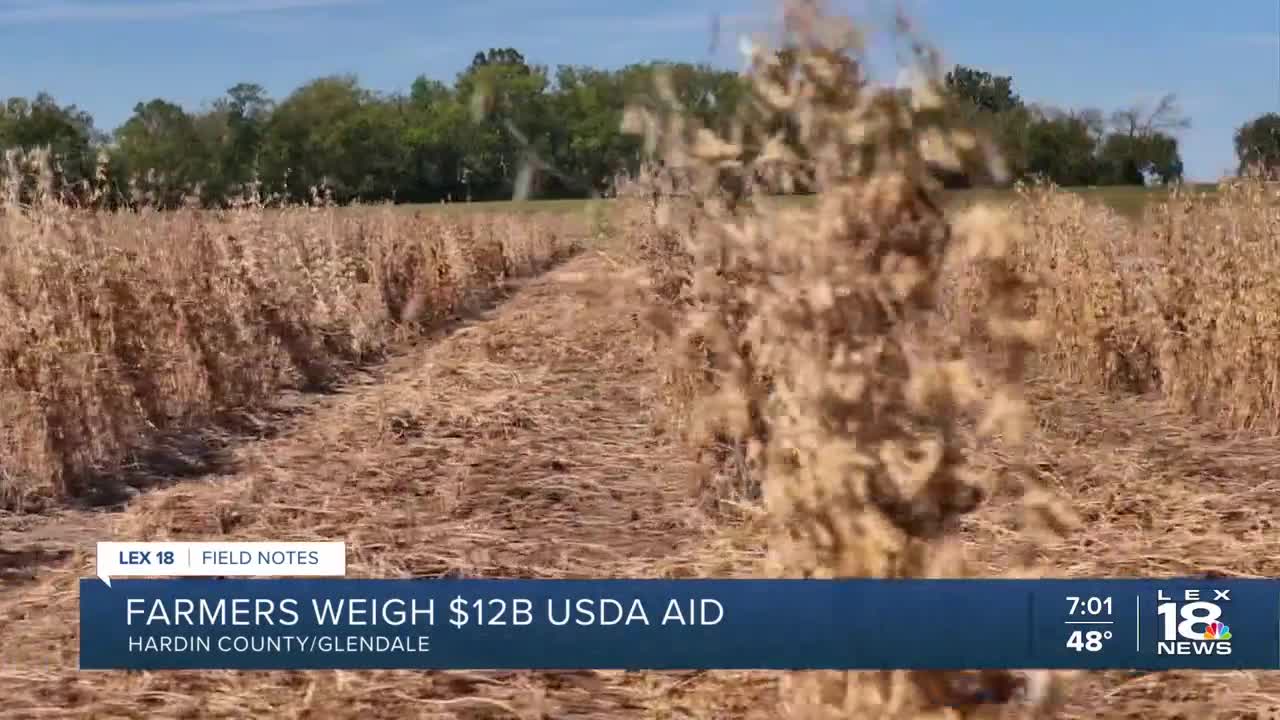


HARDIN COUNTY, Ky. (LEX 18) — The U.S. Department of Agriculture is making $12 billion available through the Farmer Bridge Assistance Program — a one-time payment aimed at helping farmers hit by trade disruptions and rising production costs.
Producers must finalize their 2025 acreage reports and apply by this Friday, December 19.
It comes after a long year of low commodity prices and high input costs, leaving farmers in limbo.
"It's putting a tight hold on farm financials at this point…knowing whether you're gonna be operating next year is a big question mark for some operations," said Houston Howlett, a Glendale farmer.
On the farm where he grew up, Howlett produces corn and soybeans. He knows the risk that comes with farming, but in recent years, the farm's future feels less sustainable.
"It's difficult, and you look at your bottom line and have difficult conversations with suppliers, with the bank, at the kitchen table, about how you want to move forward and react to the current economy. I try not to let it be emotional because it's a business, but it's hard when you put your blood, sweat, and tears into it," Howlett said.
The Trump administration says the one-time Farmer Bridge Assistance payments are designed to offset temporary market disruptions, elevated input costs, inflation and losses from unfair foreign competition.
Of the $12 billion, USDA says up to $11 billion will go to row-crop producers, with roughly $1 billion reserved for specialty crops and others. Commodity-specific payment rates are expected later this month, and USDA officials say eligible farmers should receive payments by the end of February 2026.
Payments are based on certified 2025 planted acres, so producers must finalize acreage reports by 5 p.m. ET on Friday, December 20. USDA also plans a per-producer payment cap of $155,000 and an adjusted gross income eligibility limit.
As Howlett explains, his relief may be overshadowed by his beliefs about government assistance.
"I don't sit there and hope the government will bail me out of my business," he said. "Unfortunately, the reality is, if I don't participate in the subsidy and my neighbor down the road is, that's gonna take me down lower on a competitive advantage in the following year more than we already are. I don't know how else to put it…you're damned if you do, damned if you don't."
Across the board, reactions to the bridge payments are mixed.
In Trump's announcement he pointed the finger at "four years of disastrous Biden Administration policies that resulted in record high input prices and zero new trade deals."
The Center for American Progress argued the payments are "nothing more than a band-aid that would not be necessary if trade policies had not failed American farmers and ranchers."
If you ask Howlett, the bailout doesn't address deeper, long-term issues facing agriculture and he hopes to see a reliance on subsidies fade.
"I don't feel like the government should pay me for anything, but this can't be the answer for long-term. We can't continue this route if it doesn't end on a positive note for farming. Otherwise, the industry could collapse if we don't have a market for what we produce," Howlett said.
For questions, USDA has set up farmerbridge@usda.gov and local FSA offices can help with acreage reports.
