

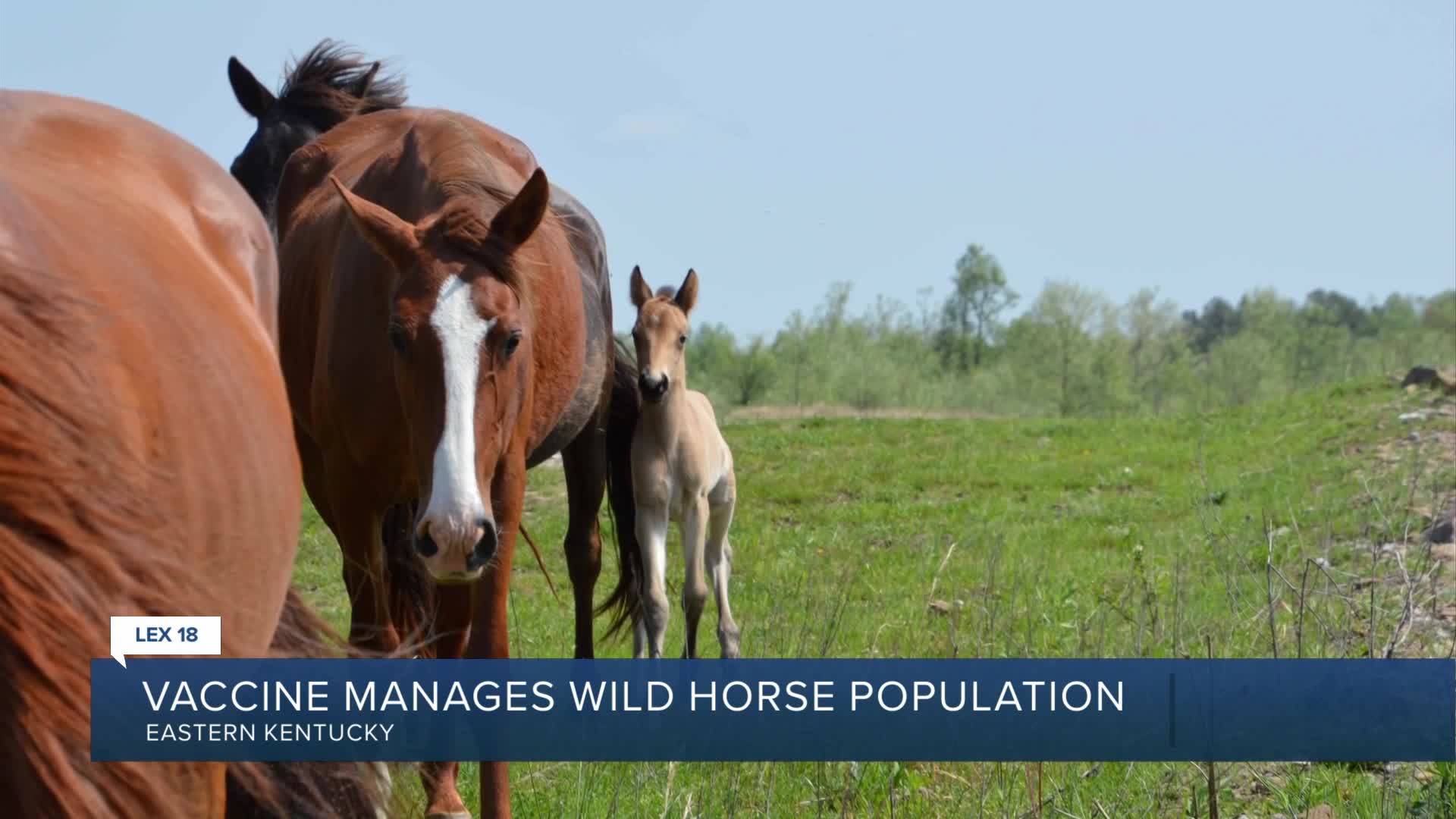


MAGOFFIN COUNTY, Ky. (LEX 18) — Once-domesticated horses abandoned on old mining sites in eastern Kentucky have been roaming free for decades, and their growing population is now straining the land, threatening wildlife and causing serious accidents on rural roads.
The Kentucky Humane Society is responding with a new fertility vaccine program aimed at bringing the population under control.
Lori Redmond with the Kentucky Humane Society has been working with this population of horses for about a decade. She said seeing their condition for the first time drove her to act.
"They're struggling on their own, and it's very different than the nice farms in Louisville and Lexington. And I saw the starving horses that were walking skeletons, and it had a very big impact on me," Redmond said.
The horses are mixed-breed animals with unknown lineage — a far cry from the thoroughbreds and saddlebreds Kentucky is known for.
"People think of horses in Kentucky as the bluegrass, and the black fence, and the thoroughbreds, and saddlebreds, and these are the underdogs," Redmond said.
The horses are over-foraging the land, leaving the landscape barren and pushing out other wildlife.
"It causes the deer and elk to struggle... and people want them to hunt, and people turn their cattle out, and that's their source of income," Redmond said.
The new fertility vaccine offers a more proactive approach to managing the herd. Mares are darted twice in the first year, then once annually after that.
"It changes from us being reactive, trying to get a hold of horses as they need help, to proactive so we can control the population better through reducing the birth rate," Redmond said.
The vaccine program is expected to reduce the number of horses that need to be brought back to the Kentucky Humane Society's farm, which is four hours away from the herd. Those stays are often lengthy and costly.
"Most of the female horses are pregnant, so they have to have a baby, then go through training to be domesticated, and then find a home. So often times, they're with us a year and a half easily," Redmond said.
Redmond estimates there are around 1,000 horses currently roaming eastern Kentucky. The vaccine program runs for three years, and mares being darted now will begin to impact population numbers starting in 2027.
In the meantime, the organization is making the drive from the farm to the horses about a dozen times each spring and a dozen times each fall — hundreds of miles one way — using two trucks, a trailer and an ATV each trip.
"It could easily cost $300 in fuel each time," Redmond said.
The Kentucky Humane Society says community help is welcomed to ensure the vaccine program works toward long-term results.
