

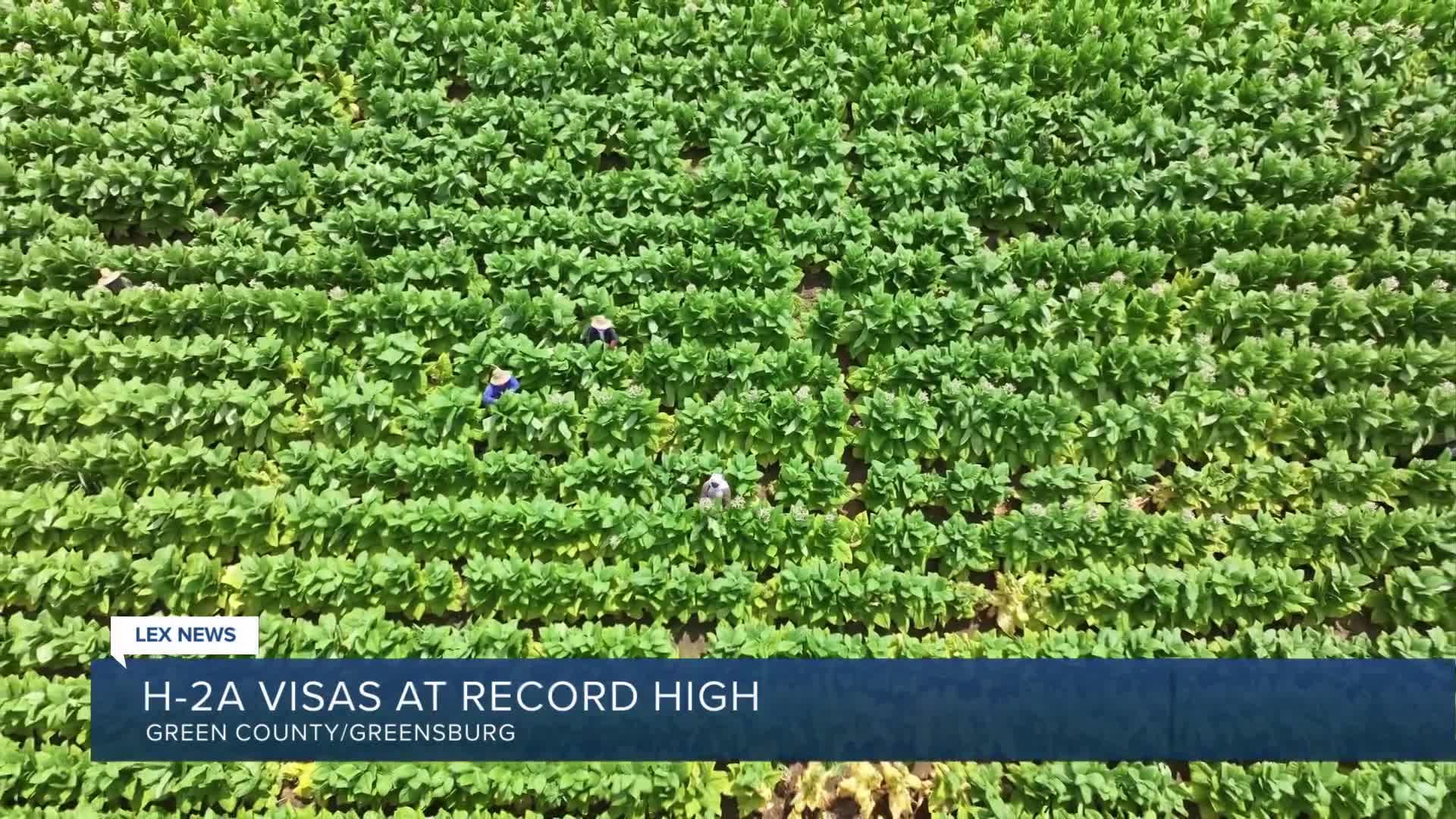


GREEN COUNTY, Ky. (LEX 18) — Larry Clark remembers plowing tobacco with a mule on the same Green County land where he still farms today.
"When I was 8 or 10 years old, I remember coming down here and raising tobacco with a mule, plowing tobacco with a mule on this farm right here we're standing on," Clark said. "I've been on this land all my life."
A lot has changed since Larry and Sundown Clark were children, with their families farming tobacco on opposite ends of Green County. The scale alone tells the story.
"My dad was a tobacco farmer as well, and we raised 20 acres of tobacco when I was a kid, and that was a lot," Sundown Clark said. "My dad was one of the biggest tobacco farmers in the county with that, and now we raise almost 300 acres of tobacco."
The Clarks remember a time when their hired help was all family. Today, advances in machinery, chemicals, and quotas have transformed tobacco farming — but the need for labor has not changed.
"It's always been labor intensive, but we have to basically hire all of it now and have to hire south of the border to hire our H2A workers. They're very important to us, and if we didn't have them, we wouldn't have this tobacco because we can't get Americans to do the work," Larry explained.
By the end of this season, the Clarks will have hired 24 H2A workers. The H2A program allows U.S. employers to hire foreign workers for temporary or seasonal agricultural jobs, and certifications are now at an all-time high.
One of those workers, George Mejia, has been coming to Green County from Nayarit, Mexico for 21 years.
"When I came here, Larry told me some stuff for work…but I didn't understand anything. He said 'You just take a break,'" Mejia said, laughing.
Mejia's English has only gotten stronger over the years — and so has his bond with his employers. He was in the Clarks' son's wedding last year.
"I like coming here because they're like my family now, you know? 21 years here," Mejia said.
"It's just a very close relationship," Sundown echoed.
Relationships like this are growing as more workers return to the same farm year after year. According to the American Farm Bureau, fiscal year 2026 is already on pace to set a new H2A record, with more than a quarter-million positions certified in just the first half of the year.
But as American farms grow more reliant on H2A workers, farmers say the program — born in 1986 — hasn't kept up.
"It's very time consuming, it's a lot of paperwork, so most farmers don't have time to do that because they're planting their crop," Sundown said.
The process requires approval through multiple agencies, including the State Workforce Agency, Department of Labor, and Homeland Security.
"We've got 18 workers on the way here today, and we needed them 2 weeks ago," Larry said.
When workers are finally cleared to enter the U.S., they can only stay for 10 months — a major challenge for farms that need year-round help, such as dairy and beef cattle operations.
The Clarks are advocating for a more streamlined process, longer visas, and multiyear contracts. They also want people to better understand the workers themselves.
"I think people think that they're here taking American jobs but they're not, we're hiring them because we can't get Americans to do this job," Sundown Clark said. "Because it is so labor intensive. Hard work, hot, and it's long hours. And it's heavy, the tobacco is heavy."
Despite the demanding work, many H2A workers send their earnings home to support their families — making the program just as important to them as it is to the farms that rely on them.
"This is the country of opportunities, the United States," Mejia said, when asked about the opportunity of working in the U.S.
As American farming continues to evolve, the Clarks hope the H2A program evolves with it.
