

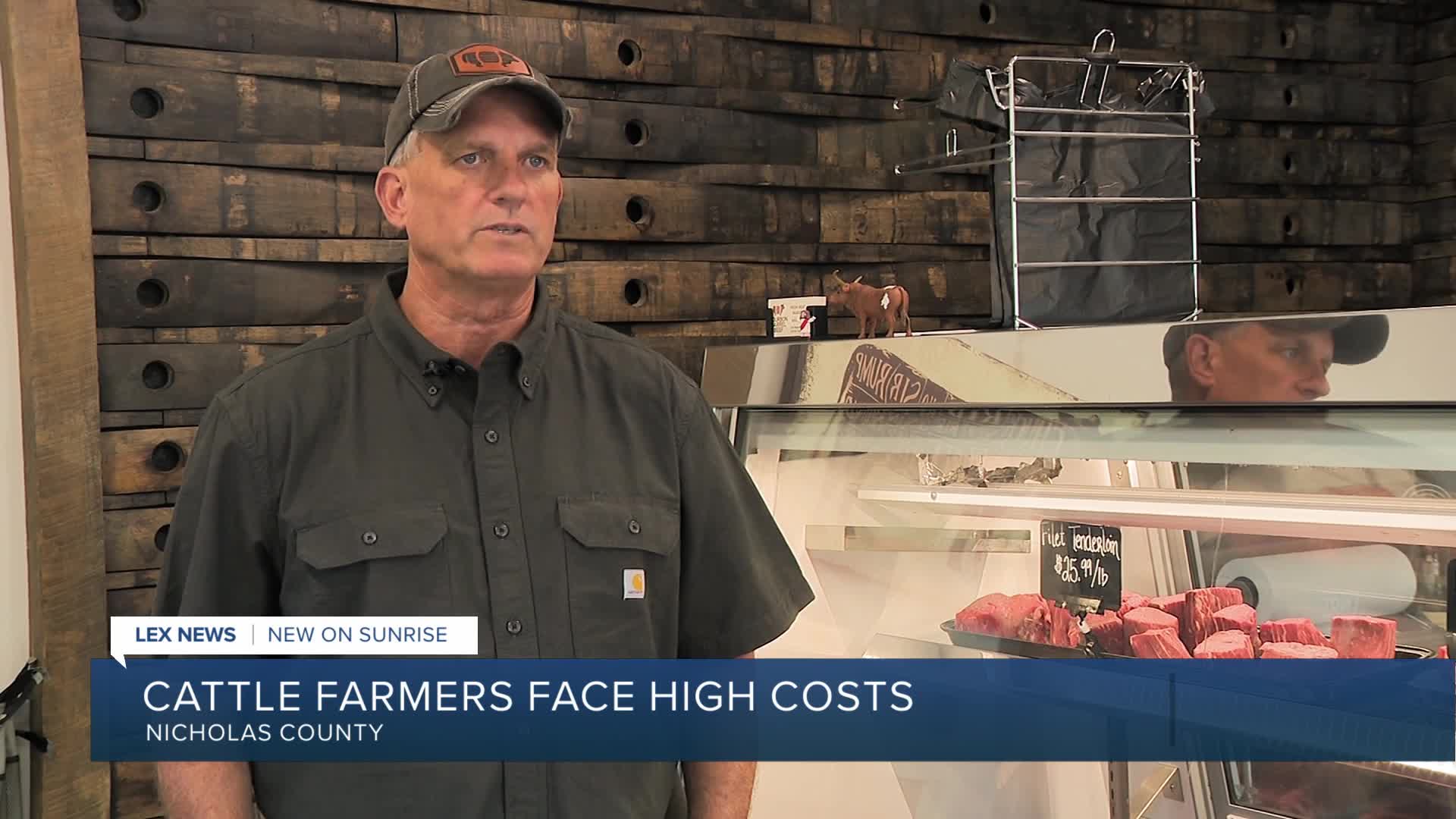


CARLISLE, Ky. (LEX News) — Perry Harrison grew up in the business and saw the problems coming years ago. To get ahead of them, he purchased some land near his Nicholas County farm and built the Harrison Harvesting processing center. He then added the first of four Bourbon Barrel Beef retail locations.
"I have wiggle room because we'll just shrink our margins if prices are too high," Perry said last week.
Because of his on-site processing and retail operations, he has that luxury. Other cattle ranchers, he knows, can't do the same, so they're hurting.
From extreme weather conditions across the nation to disease spreading within herds, the problems aren't unusual, but they are problems nevertheless. A recent plan by President Trump to import beef from South America is expected to flood the market with product that might lower the price of ground beef, but won't help America's farmers with their bottom lines.
Perry says the above issues are cyclical, and while they need to be taken seriously, they won't necessarily derail the entire industry. There are, however, two problems that could have long-lasting negative impacts. He grew up in the business and took over for his dad. Perry is concerned that the lineage on his farm could end with him. And he's seeing it happening with farming families everywhere.
"It's a huge problem. There are a couple of reasons. The main reason is cost of land has gone up so high, so what you can do with that land, as far as farming or ranching, doesn't pay for itself," he said.
Perry said, hinting at solar farm panel projects, affordable housing, and data centers, which all play a role in making land more valuable than it is for farming. He says the older generations will fight thought issues, but the younger generation of farmers is looking elsewhere.
Then there's the matter of selling off reproductive cattle before it's time to do so. That, Perry states, has become arguably their biggest problem.
"The sales price is just too good to pass up. Right now, it's more money than they've ever seen. It's hard to tell them not to take $2,500 for a calf when 3 or 4 years ago it might've only been $1,200." Perry said. "It makes sense, I understand why, that's why I think there needs to be some (federal) incentive to hold back to recreate our breeding stock," he added.
Perry is selective about the cattle he brings onto his farm. He won't buy at auction and stays away from herds that have been given hormones. That makes his work a little more difficult, but there's a reason he sticks to those values.
"If I'm low on inventory, I can't just go out and grab any animal. We actually DNA test all of the calves we get, or raise. It's something that's proven to be very valuable on our side because we want you to have the same experience today that you do next week and next month," he explained.
Michael Berk is committed to covering the stories that matter to you. If you have an idea, please reach out to Michael at michael.berk@wlex.tv.
 Facebook
  TikTok
  YouTube
 Instagram
 Threads
 X
X