

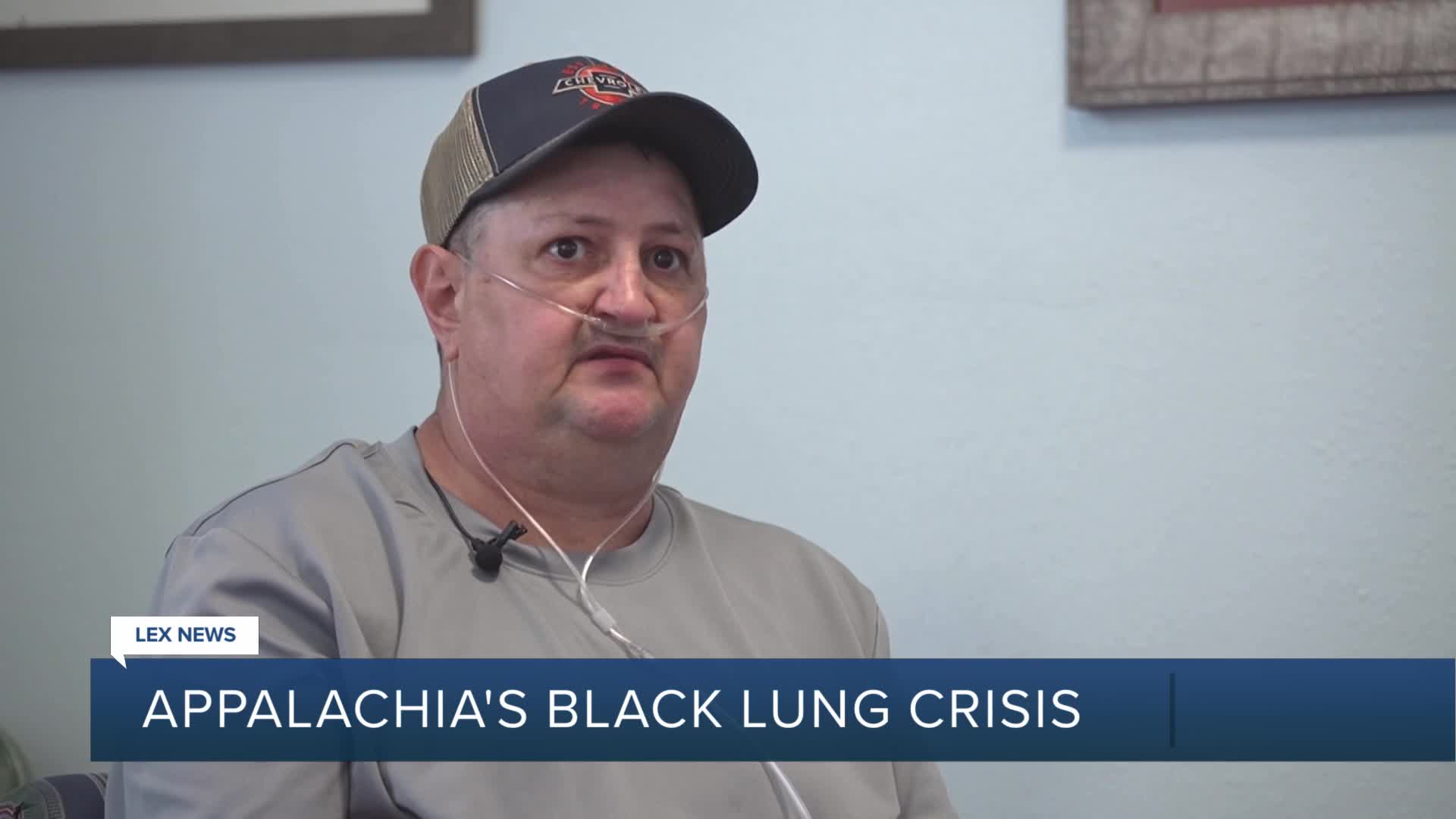


WHITESBURG, Ky. (LEX NEWS) — James Cook, a retired coal miner from Letcher County, doesn't go anywhere without his oxygen tank.
"I'm on it 24/7 now," he said. "It started out, I was on it at nighttime."
He brought it with him to the Appalachian Citizens' Law Center in downtown Whitesburg, a constant reminder of the battle he's fighting at 54 years old. Cook is suffering from the effects of black lung.
The progressive disease is caused by inhaling coal and rock dust, and rates of the illness in Appalachia are at the highest rate in 50 years, according to new data in a letter from the National Institute for Occupational Safety and Health (NIOSH).
"I just started getting short of breath," Cook said. "The things I used to do like go wading and fishing. I can't do it anymore, and I loved it, you know, I loved going fishing like that."
Before Cook went underground, he was an ambulance driver. He said he got married, needed more money, and mining jobs paid better. He retired from mining in 2015 after a more than 20-year career.
"People that don't work in the mines, they can go home and take their shirt off and shake it and nothing happens," Cook said. "I take my shirt off or another coal miner's shirt and shake it, a big cloud of dust, and you imagine what's going in your lungs, and it's in that shirt."
Experts LEX News spoke with say the disease is striking miners younger and progressing faster than ever before. They blame silica dust, which is far more toxic than coal dust.
"We're just mining so much more rock along with the coal," said Wes Addington, the executive director of the Appalachian Citizens' Law Center. "Because the coal seams are so small now, miners are getting exposed to much more deadly silica dust than they ever have in the past."
Addington represents coal miners and their families, providing free legal services to help survivors of black lung, like Cook, get the benefits they are owed.
"Unfortunately, the United States has done a terrible job over the past couple of decades protecting them from overexposure to dust," he said.
And when miners do get sick, he says, legal cases for black lung benefits can take years to resolve.
"Many of these cases can last a decade, and when you're dealing with miners that are sick as some of our clients are, they may not have that kind of time," Addington said.
Dr. Brandon Crum, a radiologist in Pike County who specializes in diagnosing black lung from X-rays, has tracked a disturbing trend over the last decade. He says his patients are getting younger, and the disease is progressing faster.
Data from his clinic shows complicated black lung, the severe stage of the disease, makes up 12 to 15 percent of cases across central Appalachia.
"I don't know how many 1,000 guys I have to evaluate or how many 1,000 guys have to die, before we fix a simple solvable problem," Crum said. "The only thing higher than our rates of black lung are excuses that we get here."
Crum, a fourth-generation miner himself, says he's been sounding the alarm for years, pushing for increased safety regulations and better benefits.
"There is no doubting it anymore," he said. "It's something that's here to stay. If you never mined another lump of coal, you would have this problem for decades because of the men that already have it and will be diagnosed with it."
Crum, and others we spoke with, want to see increased benefits for survivors through legislation like the Support Our Miners Act, which would raise the monthly disability benefit from about $800 to more than $1,200. Rep. Summer Lee of Pennsylvania introduced the bill in June.
In a letter this week, the Black Lung Association of Southeastern Kentucky asked Representative Hal Rogers of Kentucky to sign on as a co-sponsor of the Support Our Miners Act.
LEX News contacted a spokesperson for Rep. Rogers for comment and received the following statement.
"We all agree that the Black Lung Disability Trust Fund needs significant reform to ensure that our coal miners get their hard-earned benefits before this painful disease robs them from seeing a dime. I have dedicated caseworkers who advocate for coal miners in Eastern Kentucky to get their benefits every single day. Our local leaders are doing their part to advocate for our shared constituents as well.
In June, I voted for an $18 million increase for the Black Lung Disability Trust Fund in the FY27 federal funding bill for Labor, Health and Human Services and related agencies. The bill also requires the Department of Labor to speed up claims processing and increases oversight. As a senior appropriator, I helped advance the bill out of the full House Appropriations Committee and it now awaits consideration by the full House of Representatives.
Washington Democrats, led by the Obama and Biden Administrations, regulated coal mines out of business across the country, leaving us with only 3,600 coal miners in Kentucky today. They now want taxpayers to bail out the trust fund that they nearly decimated by fast-tracking coal operators onto bankruptcy and working to increase their fines from $1,000 per day to $25,000 per day. Democrats talk openly about their desire to increase benefits, but they aren’t being transparent about their movement to destroy the trust fund through their targeted War on Coal, and sticking taxpayers with the bill."
-U.S. Rep. Hal Rogers
At his office in Pikeville, Crum says mining isn't going anywhere, so he's calling for increased cooperation from mining companies, politicians, and healthcare professionals.
"People have to admit there's a problem," he said. "The coal companies and the people that represent them have to admit there's a problem or maybe even admit there could be a problem. We have to get our government agencies, the regulators together. We have to get medical professionals."
New safety rules for mines proposed in 2024 are currently held up in federal courts.
"We have to limit how much silica dust miners are breathing, and we haven't done that yet," Addington said.
Like many other families in Kentucky and across Appalachia, Cook and Crum know firsthand how deadly that dust can be.
Both men's fathers died in October of last year. Both were suffering from black lung.
"Sick of going to funerals, sick of hearing about it," Crum said. "Sick of seeing people with oxygen tanks at ball games and restaurants, sick of it."
Nearly one year after his father's death, Cook is still waiting for the federal black lung benefits he is owed. He says he is hopeful because of the legal aid he is receiving. He is proud of the work he did underground but says if he could do it all over again, he would have made a different choice.
"I would not have been a coal miner. I would have stayed, probably went and got my paramedic or something," he said. “I would have just stayed with the ambulance service. I loved that job."
Evelyn Schultz is committed to covering the stories that matter to you. If you have an idea, please reach out to Evelyn at evelyn.schultz@wlex.tv.
