

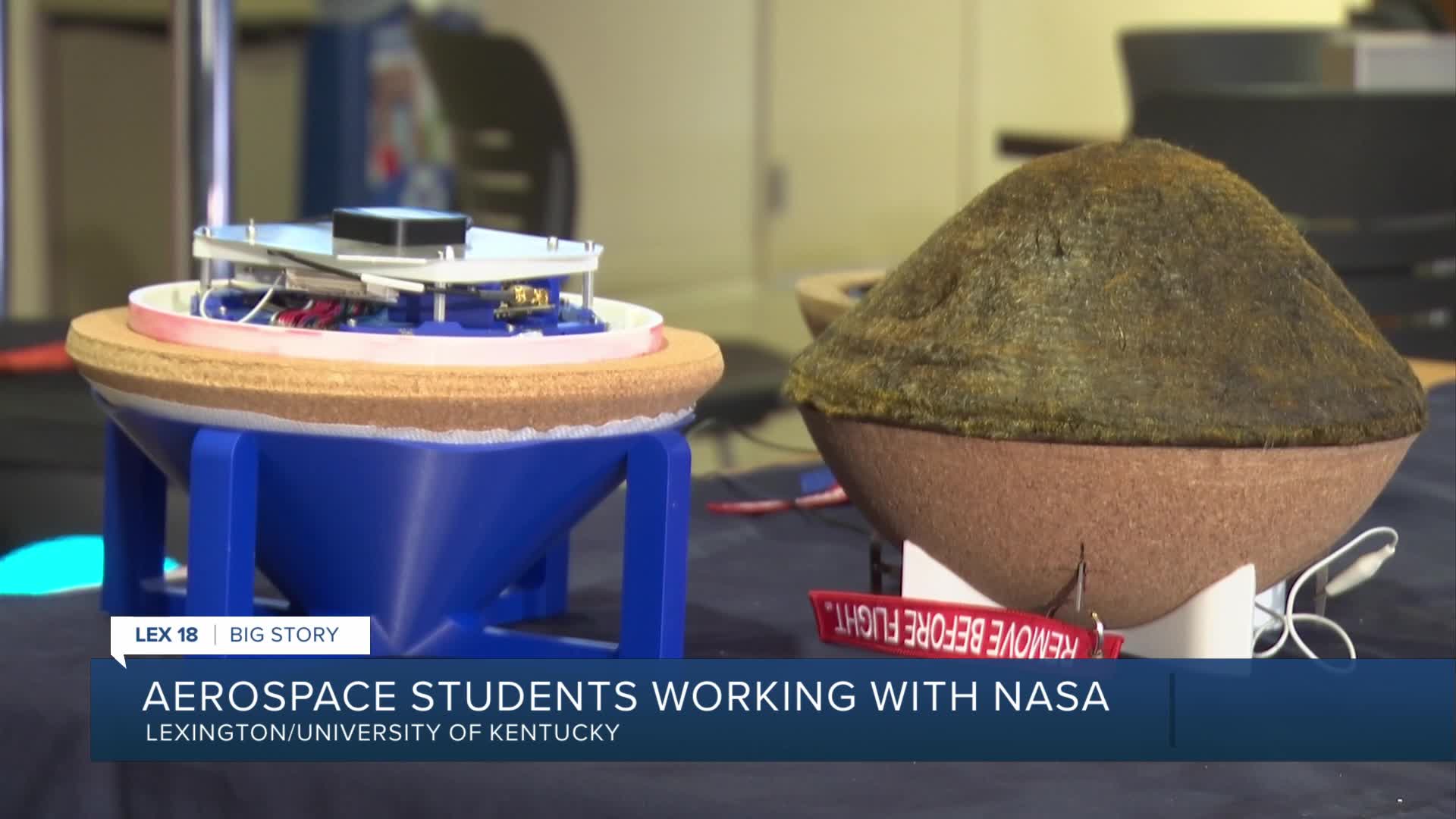



LEXINGTON, Ky. (LEX 18) — University of Kentucky engineering students are putting the finishing touches on experimental capsules that will soon embark on a journey to the International Space Station to test critical spacecraft technology.
“Our own mission is called KREPE, this is our third mission so it’s KREPE 3,” said Dr. Alexandre Martin a professor in the Mechanical and Aerospace Engineering department. “Mostly we’re going to test thermal protection system, or the heat shield,” he explained.
The students, guided by Dr. Martin, built these capsules, which contain circuit boards to record data, as well as building the heat shields to protect them upon reentry into the earth’s atmosphere. This is the critical part of the mission.
NASA will collect information on how well those shields hold up, if at all, upon reentry. Astronauts aboard the ISS will pull a pin in the protective covering to trigger the data recording part of these devices before sending them back down to earth for a splash landing into the ocean.
“It is very rare for students in aerospace to be able to work on something that will become a flight article, or space hardware,” Dr. Martin said.
Alexander Barrera is working on his PhD and admitted he pinches himself at times, knowing this is a very special opportunity.
“It’s amazing. It’s a dream come true,” he stated before sharing he has an internship lined up at NASA.
His classmate, Eric Adams has been very involved in the process as well.
“There's a lot of safety regulations, and I do the safety and mechanical side of things, so lots of paperwork, lots of making sure NASA is very happy with letting us send these up to the ISS. As you might imagine they don't let anything go to the ISS unless they know what it is,” Adams said.
The launch is scheduled for April 1 in Florida, with some students expected to attend. The capsules will spend six to seven months at the ISS before being loaded into a transporter for their return journey to Earth.
For the students who have invested months of work into the project, the waiting period will test their patience.
“Nervous. Because you send it off and then just wait and wait. You won’t know until the data comes back,” Adams said.
